




The spec workspace for developers running AI agents through Spec-Driven Development. Catch bad specs before they become bad code.
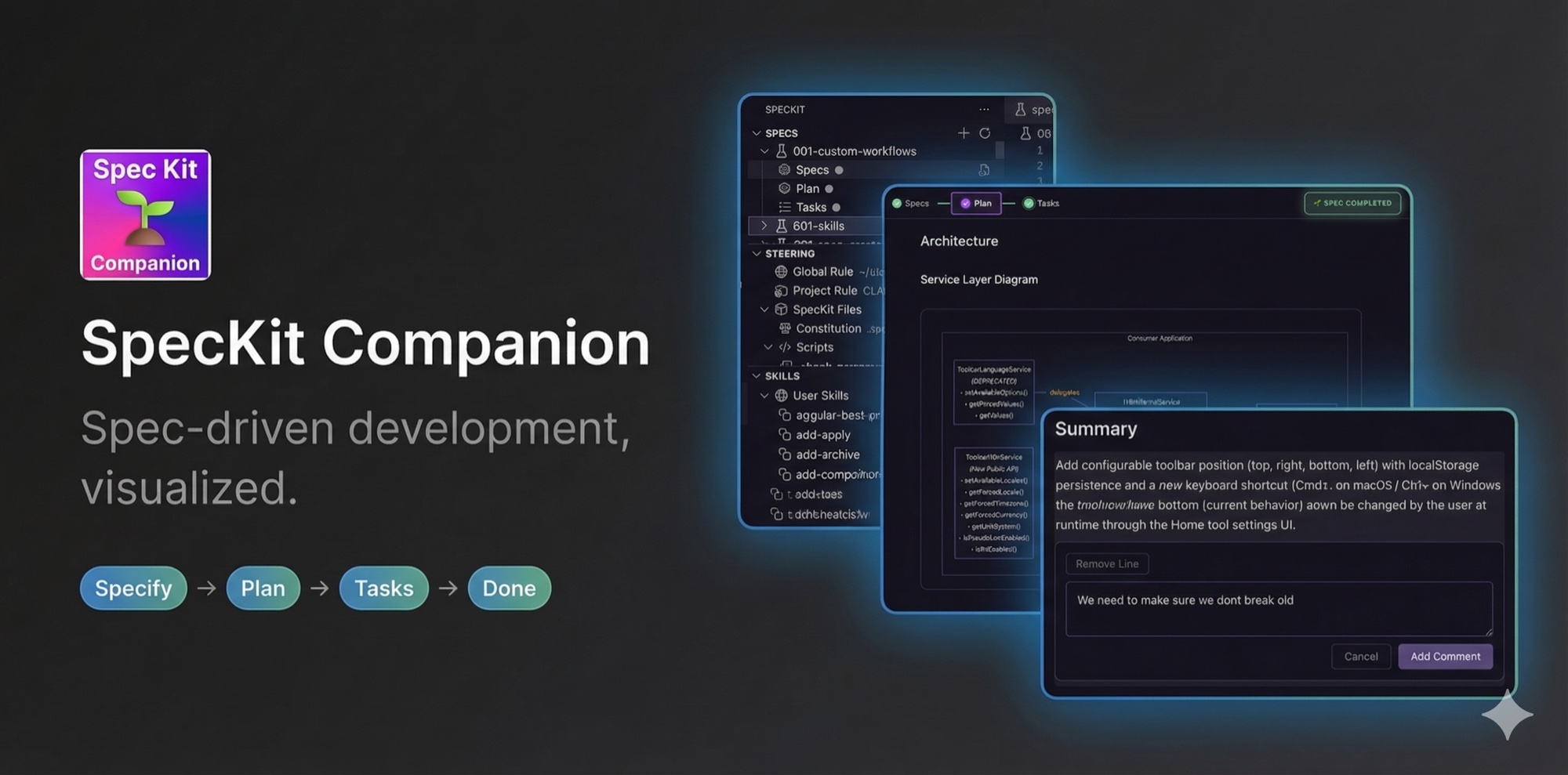
A spec workspace that turns AI-assisted, spec-driven development into something you can actually see and steer — without leaving VS Code:
- Catch bad specs before they become bad code. Review AI-generated specs the way you review pull requests: inline comments on specific lines, refine in place, and kill a vague requirement before it turns into 200 lines of wrong implementation.
- Watch every feature flow through its phases. Specify → Plan → Tasks → Done, each a one-click action, with live progress, a phase timeline, and an Activity overview of everything the spec tracks.
- Pick one pipeline, run it end to end. Choose stock SpecKit or the leaner SpecKit Companion workflow once — smaller specs, files-and-dependencies tasks, built-in right-sizing for small changes — and every step of the run dispatches that choice.
- Bring your own AI and your own workflow. Eight providers, custom phases, custom commands. Drop in your own SDD process; the sidebar and viewer adapt.
- v0.24.0 Stock specs advance past Specify on their own (no more stuck "specifying") · one switch turns on the whole SpecKit Companion experience and a single workflow choice replaces the old beta toggles · the Completed group lists only specs you've actually finished, with a sidebar Mark as Completed action and a distinct icon for implemented-but-unconfirmed · viewer polish — the footer follows the spec's own workflow, task checkboxes align at any font size, the install banner stays readable in narrow panels, faded Create-Spec placeholder · opt-in PII-free telemetry
- v0.23.0 One-click install + graceful degradation for the companion spec-kit extension (detection, banners, sidebar action) · a finished implementation reliably shows as done — the viewer auto-refreshes and the in-flight spinner is consolidated onto the step tab · in-app update notifications work again and install links resolve · the in-editor "Install/Update spec-kit Extension" always pulls the newest build · Beta Features simplified to on/off and ordered by adoption · per-spec SpecKit Companion pipeline pick in Create New Spec (beta) · higher-contrast text on dark + sidebar polish
- v0.22.0 Status + Resume — each active spec row shows its current step and last transition with an inline Resume action that continues the pipeline from where it stopped; live per-task journaling on implement (real per-task timing, not one end-of-run burst); malformed-
.spec-context.jsonrecovery with a reset action - Full changelog →
Review AI-generated specs the way you review code. Add inline comments on specific lines, refine requirements, and catch a vague requirement before the AI turns it into 200 lines of wrong code. Every comment persists to the spec's .spec-context.json the moment you add it, so an in-progress review is durable across sessions and committable to source control.
Plug any AI assistant into any spec-driven workflow. Eight providers ship today (Claude Code, Gemini, GitHub Copilot, Codex, Qwen, OpenCode, IDE Chat, Claude in VS Code), and the workflow engine accepts custom phases, commands, and sub-documents. Drop in Agent Teams Lite, your own SDD process, or anything that takes commands and produces markdown.
Spec-driven phases without leaving VS Code. Each feature flows through Specify, Plan, Tasks, Done, with progress tracking, sticky headers, and a structured viewer built for long specs.
Guide your features through structured phases with a dedicated viewer that renders markdown specs, shows phase progress, and provides one-click actions for each step. Mermaid diagrams render inline with zoom controls for navigating complex diagrams. After each action, a toast confirms the result and the viewer auto-advances to the next phase.
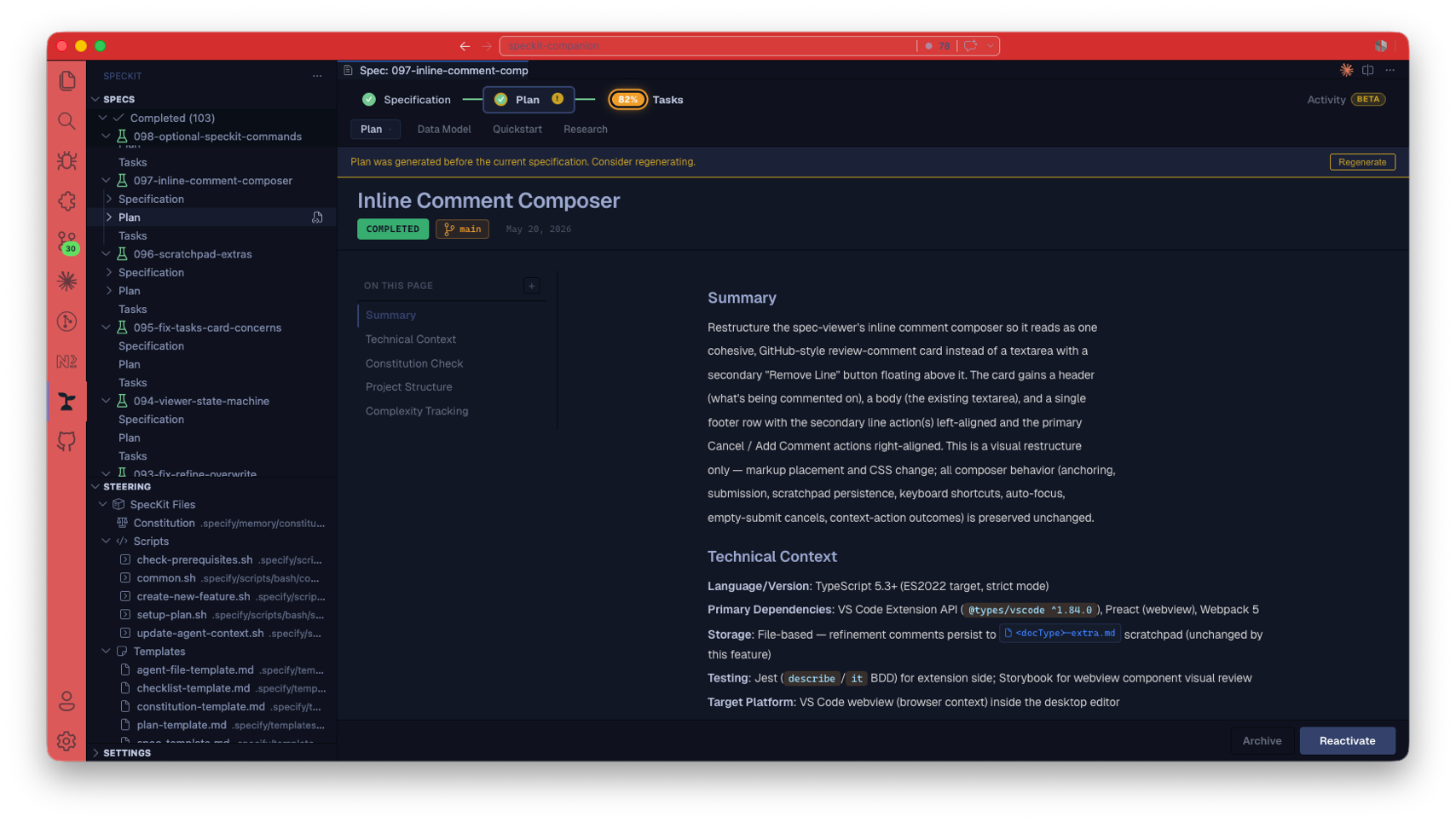 The spec viewer. Step tabs, sub-document chips, an inline diagram, and a footer button that advances Specify → Plan → Tasks → Done. Markdown stays in your repo, never on a server.
Review spec documents with inline comments. Add feedback directly on specific lines, refine requirements, and collaborate on specs before implementation begins. Each comment is persisted to the spec's .spec-context.json the moment you add or remove it — not only when you refine — so an in-progress review survives closing the tab, is committable, and can be picked up later (next session, another machine, or another reviewer after a pull). When you click the Refine button, that document's pending comments are dispatched to the AI for a direct, in-place edit of the source and then marked applied (kept as history — no separate files).
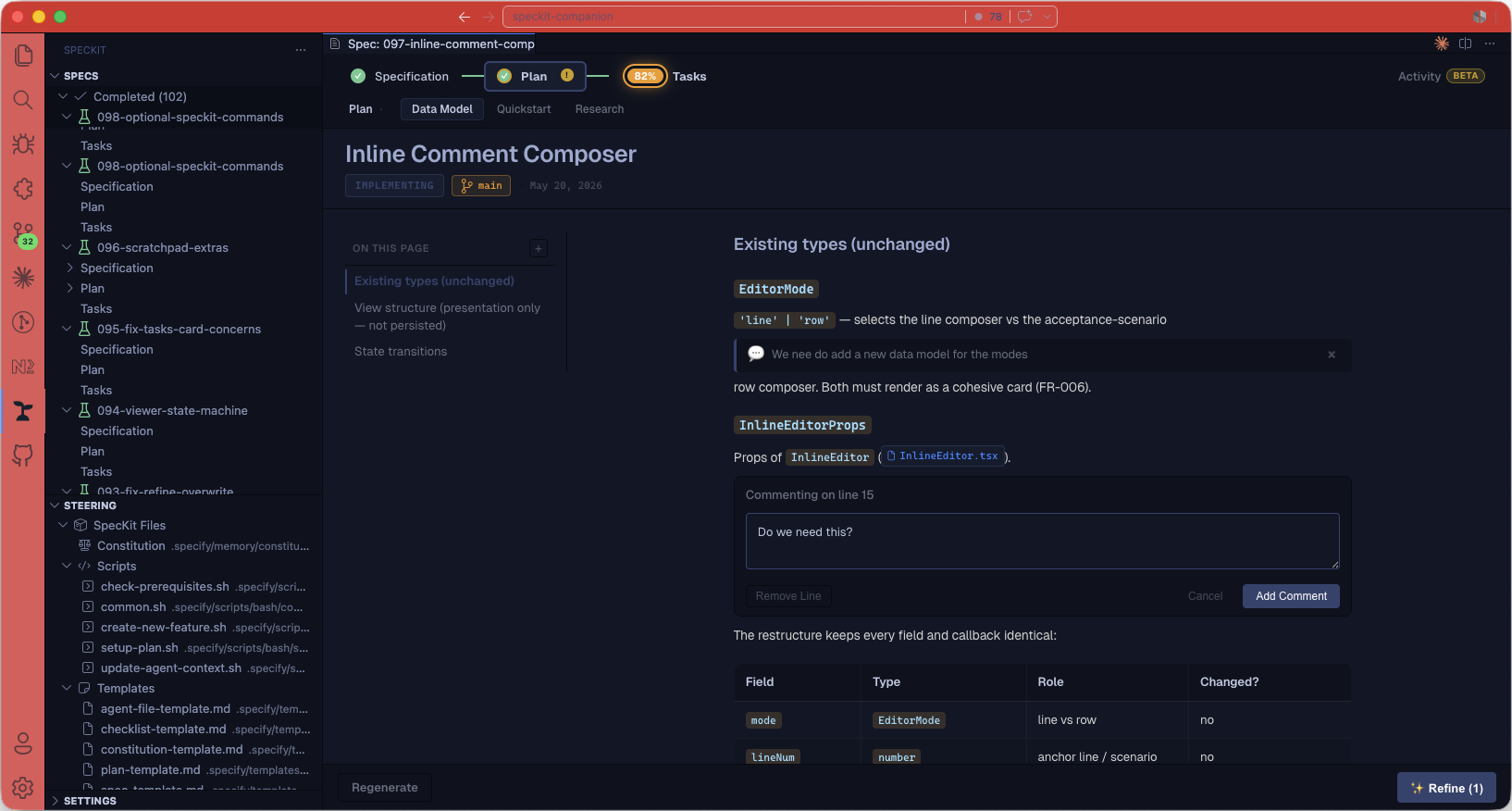 Inline review comments. Catch a vague requirement on line 12 before the AI turns it into 200 lines of wrong code.
Reopen a spec and every pending comment is restored inline, anchored to its source location. Restore is resilient: a comment remembers its nearest heading and surrounding block, so if the source drifted (a line moved or was edited) it best-effort re-anchors to the nearest matching heading rather than being dropped — a comment is never silently lost.
Comments live entirely in .spec-context.json; the old per-document <doc>-extra.md scratchpad files and the read-only "Notes" sub-tab have been removed. There is one storage surface (the committed context file) and one overview surface (the Activity panel's Review comments card — a consolidated list across spec/plan/tasks with per-comment status, jump-to-line, and a per-document Run refinement action). The inline surface stays the always-on primary path; the Activity list is the power-user overview (when the Activity panel is toggled off, inline comments still work and still persist).
Create new specs with a dedicated dialog. Write a detailed description, select your workflow, and attach screenshots or mockups for context. The form is a centered, readable-width column with persistent writing guidance below the field, and the Create Spec button stays disabled until you've written something. When the SpecKit Companion workflow is selected, an Auto button appears next to it that builds the whole spec hands-off — it walks specify, plan, tasks, implement, and completion on its own, with no approval pauses in between — for when you want to describe what you need and walk away. Pick Create Spec for the normal step-by-step flow, or Auto to run the whole pipeline. (Auto needs the companion spec-kit extension; without it the button warns, and with stock SpecKit selected only Create Spec appears — the step-by-step flow always stays available.) The dialog is built for keyboard and screen-reader use: errors, in-progress submission, and image attach/remove are announced, every control has a visible focus ring and a meaningful name, the character limit is conveyed beyond color (and over-limit content can't be submitted), and pressing Esc with typed content asks before discarding.
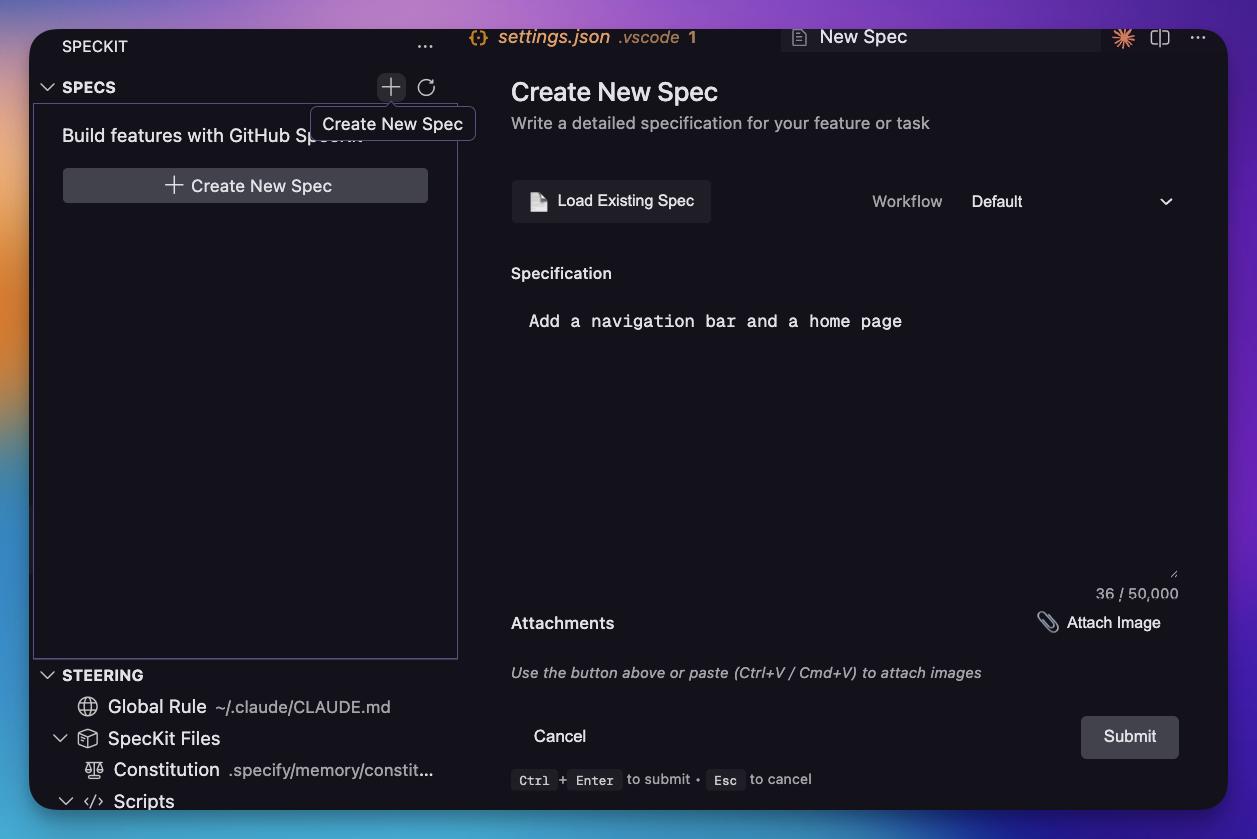 Create-spec dialog. Write a detailed description, pick a workflow, attach a screenshot. The AI never sees a one-liner.
Each feature flows through four phases, each a one-click footer action in the viewer above:
- Specify — define requirements with user stories and acceptance scenarios before any code is written.
- Plan — create the technical design: architecture, data models, and research, grouped under one step with sub-document chips.
- Tasks — generate an implementation checklist with parallel-execution markers and live progress.
- Done — mark the spec complete (or archive it) once implementation lands.
The spec viewer is built for fast scanning of long-form specs:
- Title-leading header: the spec name dominates above a compact
[STATUS] [⌥ branch] · datecluster, so the page anchor is the first thing your eye lands on. - Sticky chrome: step tabs (Specification / Plan / Tasks) and header stay pinned at the top while you scroll.
- Children rail: when a step has sub-files (e.g., Plan's
data-model.md,quickstart.md,research.md), they render as chips directly under the active step tab, with the parent step itself as the first chip so any sub-doc has a one-click path back to the overview. - Persistent inline comments: review comments persist to
.spec-context.jsonas you make them and restore inline when the spec reopens (best-effort re-anchoring if the source drifted). The old per-document… Notesscratchpad sub-tabs are gone — the consolidated cross-document list now lives in the Activity panel's Review comments card. - Table of contents: sticky outline column on the left of the content area. Defaults to h2-only (so phase-heavy
tasks.mdreads as a clean ~7-entry list); a small+toggle expands h3 subsections when needed. Auto-hides on narrow panes. - Quiet content: when the structured header has the metadata, in-content duplicates (the
Input:block, repeated branch chips, literalSlug:/Date:paragraphs) are suppressed so the body is just the spec content. - Diagrams: wide mermaid diagrams scroll horizontally inside the prose column instead of bleeding past it. Each diagram has its own
−/ Reset /+zoom controls. - Activity panel: an
Activitytoggle swaps the markdown pane for a card-stack overview of everything.spec-context.jsoncarries. See Activity Panel below. - Quiet, intentional footer: the footer surfaces only what fits the moment —
Regenerateplus a forward button labelled with the next phase (Plan/Tasks/Implement/Complete). While a step generates, that button is disabled and readsGenerating <step>…until the artifact actually lands on disk, so the footer never advances ahead of the work.ArchiveandMark Completedappear only once the spec is closure-eligible (ready-to-implementand beyond). Seedocs/viewer-states.mdfor the full footer state matrix. - Optional SpecKit commands per tab: SpecKit's three refinement commands surface as one-click footer buttons where each is most useful — Clarify on Spec, Checklist on Plan, Analyze on Tasks. No configuration required; a custom command with the same id wins. They disappear once the spec reaches the closure gate.
Toggle Activity in the viewer's nav bar to swap the markdown pane for a card-stack overview of everything .spec-context.json carries:
- Approach — one-line strategy, status pill, PR link, and commit/PR checkpoints.
- Phases — a horizontal timeline reporting active time per step and substep (idle gaps are capped, so an overnight pause doesn't inflate a step); the in-flight step pulses and the terminal phase finalizes.
- Tasks — per-
T###status, summary, file chips, and inline concerns. - Decisions, Concerns, Review comments (every persisted comment grouped by document, with jump-to-line and a per-document Run refinement button), and Files touched (clickable).
Each card hides itself when its data is missing, so a minimal speckit-style spec collapses to just Phases. Visibility is gated by speckit.viewer.activityPanel — "off", "beta" (default; toggle shows a beta pill), or "on".
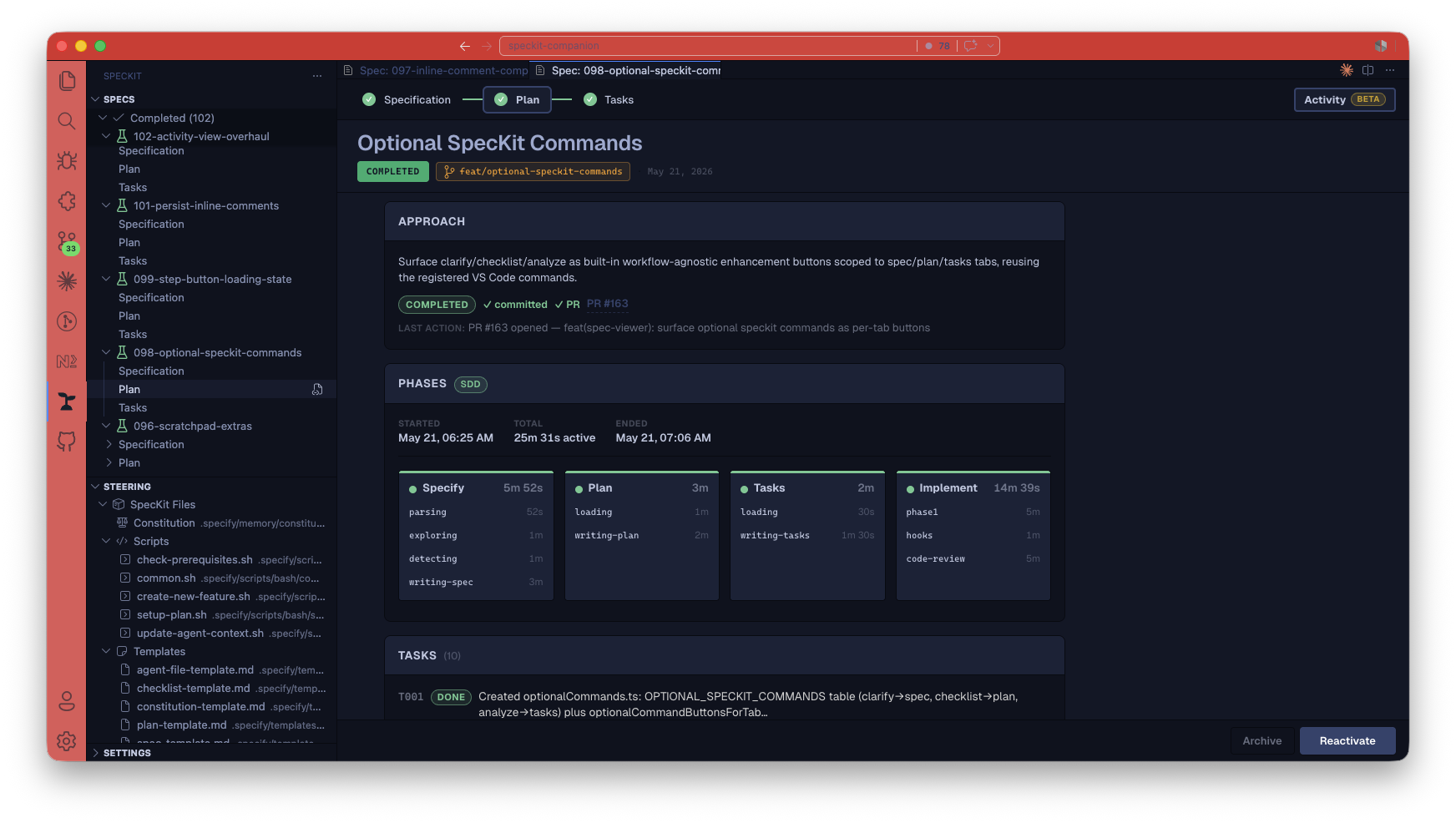 Activity panel. The Phases timeline plus Approach, Tasks, and Review-comments cards — one overview of everything the spec's context file tracks.
SpecKit Companion isn't tied to a single methodology. Swap out the default phases for any SDD workflow such as Agent Teams Lite, your own team's process, or anything that uses commands and produces markdown files. Define custom steps, labels, output files, and sub-documents. Add custom commands that appear as action buttons in specific phases (e.g., Verify, Archive, Commit, Create PR).
The sidebar, progress tracking, and workflow editor all adapt automatically to your custom workflow. See Configuration below.
The sidebar organizes everything your AI assistant needs: Specs for feature development, Steering for AI guidance documents, Agents for custom agent definitions, Skills for reusable capabilities, and Hooks for automation triggers.
Specs are grouped into three collapsible sections, each with a count in the header: Active, Completed, Archived. The Completed group holds both confirmed-completed specs (green beaker) and implemented specs awaiting your confirmation (yellow beaker) — right-click an implemented spec for Mark as Completed to confirm it. Filter by name, sort by number/name/date/status, multi-select to bulk-archive or complete, and right-click for per-spec actions like Reveal in File Explorer. Right-click also offers Copy Path (workspace-relative path) and Copy Name (slug only) for referencing specs in PRs, chat, or external tools. Right-click a group header to apply lifecycle actions to every spec in the group at once (e.g., Archive all, Reactivate all) — each gated by a confirmation dialog. Header badges and tree icons are color-coded by status so progress reads at a glance.
Each active spec row shows its current step and a one-line last transition (e.g. plan — Plan started · 2h ago) and an inline Resume action. Clicking Resume dispatches /speckit.companion.resume for that spec: the pipeline continues from the recorded step, with prior decisions in scope, and the next /speckit.* command is sent to your AI provider — continuing at the next unchecked task when mid-implementation. The row updates live once the dispatched step records its state. See docs/sidebar.md for the full reference.
When a step command is running, the spec shows a spinner and a live elapsed timer; a step-complete notification fires when it finishes (toggle via speckit.notifications.stepComplete).
The spec-kit upgrade commands are consolidated behind a single Upgrade… icon in the Specs view title bar. Clicking it opens a picker with Upgrade All, Upgrade Project, and Upgrade CLI — the project-scaffolding actions use your configured AI provider, while Upgrade CLI updates only the global CLI. All three remain available individually from the Command Palette.
The sidebar is visible alongside the viewer in the screenshot above. For the full reference (lifecycle button matrix, badge tier mapping, transition logging, all icon meanings), see docs/sidebar.md.
Fonts (Geist Variable) and icons (codicons) ship bundled inside the extension .vsix. The spec viewer, spec editor, and workflow editor all render identically on a plane with no internet connection. No runtime requests to CDNs for fonts or icon glyphs.
Actions that change the spec's lifecycle are protected so a misfired click is easy to walk back:
- Regenerate queues behind a 5-second undo toast. Clicking Undo or pressing Esc cancels the regeneration; otherwise the backend fires when the timer elapses.
- Archive, Complete, and Reactivate each require two clicks. The first click swaps the button label to "Confirm?" for 3 seconds; a second click within that window confirms. Otherwise the label reverts silently and nothing happens.
- Locked future steps: while a step is running, downstream step tabs lock and surface a tooltip explaining why, so dispatched work cannot be interrupted by an out-of-order click.
- The OS-level Reduce Motion preference is honored globally. In-flight step pulses and other infinite animations stop when it's enabled.
- Install the extension from a
.vsixfile or the VS Code marketplace - Open the sidebar: the SpecKit icon is always visible in the activity bar; with no folder open, clicking it shows an empty-state panel with an Open Folder action
- Create a spec: once a folder is open, click the
+button in the Specs view to start your first feature
There are two installs, and they're independent:
- The VS Code extension (this product) — the Visual Spec Viewer, inline review comments, the sidebar, and command dispatch. Install it from the VS Code Marketplace (or a
.vsix). This works on its own. - The companion spec-kit CLI extension — adds the lean
/speckit.companion.*pipeline and the lifecycle capture hooks that drive the Activity timeline. This is a spec-kit CLI extension, not a VS Code Marketplace extension, so it installs through thespecifyCLI.
One-click from inside the editor. When the spec-kit extension is missing, an Install spec-kit extension banner appears in the Create-Spec and Activity panels, and an install icon appears in the Specs sidebar. Click it and the extension runs the install in an integrated terminal — no copy-paste. (Already have it installed? You'll never see the banner.)
Manual install. You need a github-source spec-kit CLI first — the stock PyPI specify-cli does not ship the extension subcommand:
# 1. github-source spec-kit CLI (required: stock PyPI specify-cli lacks `extension`)
uv tool install specify-cli --from git+https://github.com/github/spec-kit.git --force

# 2. the companion spec-kit extension (installs/updates; --force is idempotent)
specify extension add companion --from https://github.com/alfredoperez/speckit-companion/releases/download/companion-latest/companion.zip --force
The
companion-latest/companion.zipURL is a stable rolling asset — it always serves the newest build, so the same command installs and updates (re-run with--force). Once the extension is listed in the spec-kit catalog, it shortens tospecify extension add companion --force.
Update it later from the Specs view Upgrade… menu → Update spec-kit Extension (runs the same install with --force).
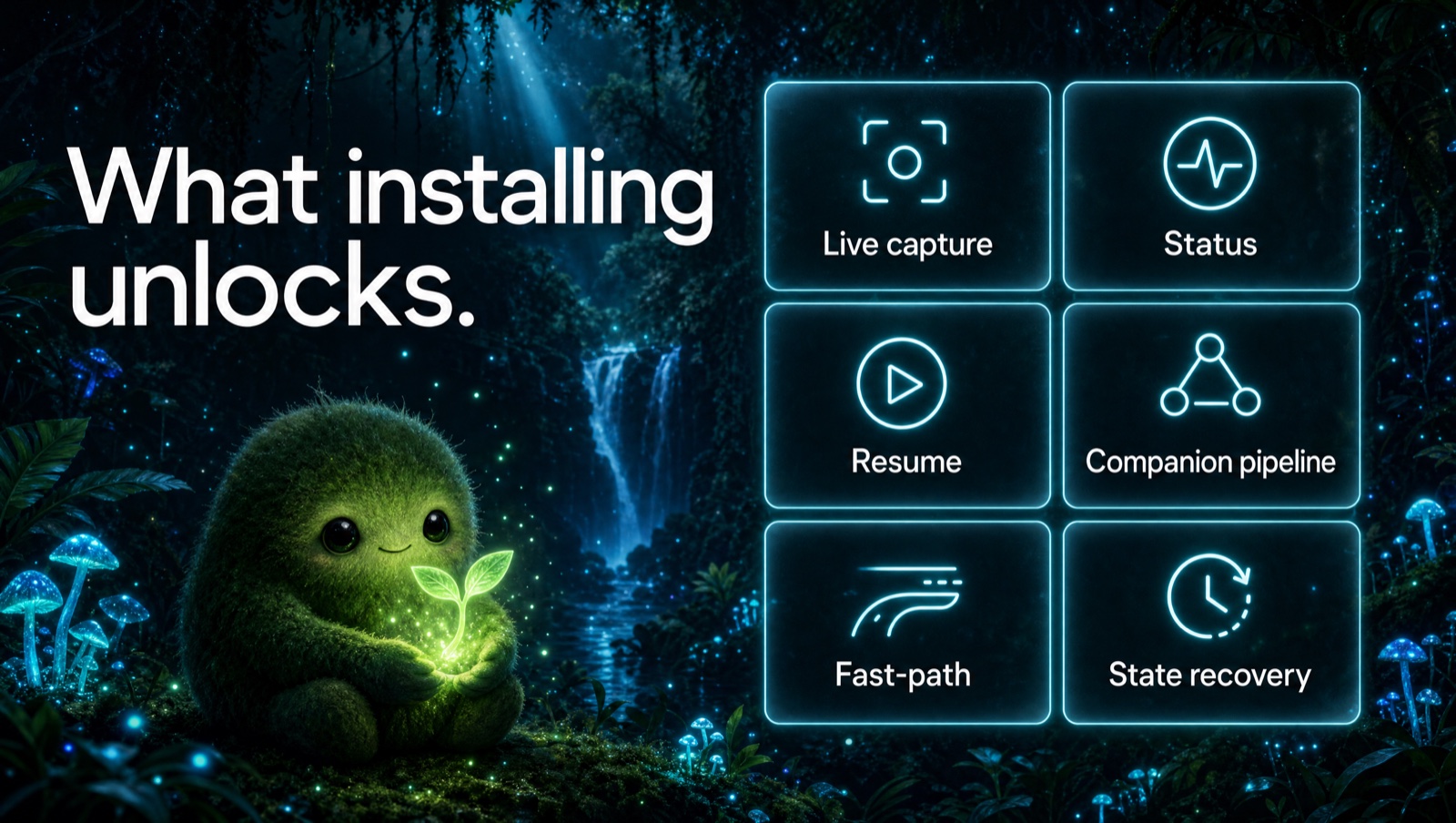
SpecKit Companion is one extension that sits on top of a spec-driven workflow — it does not replace the command-line spec-kit process, and most of its pieces are optional. Here's what's actually required:
| Component | Required? | What it's for |
|---|---|---|
| SpecKit Companion extension | Required | Everything in this README — the Visual Spec Viewer, inline review comments, the sidebar, and command dispatch. Install it and the spec-review workflow works. |
spec-kit CLI (specify) |
Optional | Only needed to run the /speckit.* phase commands (specify / plan / tasks / implement) that the extension dispatches. Install it via specify init (the upstream spec-kit project). The viewer and review comments work without it. |
.specify/ scaffolding |
Optional | Generated by specify init in your workspace; holds spec-kit's templates and the /speckit.* command definitions your host AI resolves. Present only if you use spec-kit phase commands. |
companion hook in .specify/extensions.yml |
Optional | Wires the extension's git steps (branch, commit) into spec-kit runs. A convenience for spec-kit users — not required for the extension itself. |
What the extension does on its own. The extension's only runtime coupling to an AI provider is dispatching command text: it assembles a prompt and hands it to a terminal CLI, the host editor's built-in chat, or the Claude Code panel. It never installs the spec-kit CLI for you and never reads a provider's response back. The Visual Spec Viewer and inline review comments read and write the spec markdown and .spec-context.json files directly, so they work with no CLI installed at all.
Extension dispatch vs. running spec-kit in a terminal. Whether a phase is driven by clicking a footer button in the viewer or by typing /speckit.specify yourself in a terminal, the work lands in the same place: the spec markdown under .claude/specs/<spec>/ plus the .spec-context.json that tracks state. There is no separate extension-owned database — the on-disk spec files are the single source of truth. That makes the two surfaces interchangeable and never competing: drive a step from the terminal and the viewer reflects it on the next file change; drive it from the viewer and your terminal sees the same files. Neither "owns" the workflow — they're two front-ends over one set of files.
For the dispatch styles (terminal CLI vs. the editor's built-in chat vs. the Claude Code panel), see Supported AI Providers — IDE Chat and Claude in VS Code route the prompt to an in-editor surface instead of a terminal, but the file-ownership model above is identical. For a deeper architecture walkthrough, see docs/how-it-works.md.
Looking for "what does good look like?" The repo's own specs/ directory is the answer. Every feature ships with the spec that drove it. A few worth opening:
specs/008-spec-viewer-ux/: full SpecKit flow: spec, plan, research, data model, quickstart, tasks, plus checklists and contracts.specs/065-multi-select-specs/: minimal SDD flow: justspec.md+plan.md+tasks.mdfor a small UX change.specs/051-explorer-viewer-fixes/: minimal SDD flow: same minimal shape, applied to a focused bug-fix bundle.
Compare the file lists side by side to see the contrast between the full and minimal flows.
| Feature | Claude Code | GitHub Copilot CLI | Gemini CLI | Codex CLI | Qwen Code | OpenCode | IDE Chat | Claude in VS Code |
|---|---|---|---|---|---|---|---|---|
| Steering File | CLAUDE.md | .github/copilot-instructions.md | GEMINI.md | AGENTS.md | QWEN.md | AGENTS.md | Not supported | CLAUDE.md |
| Steering Path | .claude/steering/ | .github/instructions/*.instructions.md | Hierarchical GEMINI.md | Hierarchical AGENTS.md | .qwen/steering/ | Hierarchical AGENTS.md | Not supported | .claude/steering/ |
| Agents | .claude/agents/*.md | .github/agents/*.agent.md | Limited support | Hierarchical AGENTS.md | Not supported | .opencode/agent/*.md | Not supported | .claude/agents/*.md |
| Hooks | .claude/settings.json | Not supported | Not supported | Not supported | Not supported | Not supported | Not supported | .claude/settings.json |
| MCP Servers | .claude/settings.json | ~/.copilot/mcp-config.json | ~/.gemini/settings.json | ~/.codex/config.toml | ~/.qwen/settings.json | ~/.opencode/opencode.jsonc | Not supported | .claude/settings.json |
| CLI Command | claude |
ghcs / gh copilot |
gemini |
codex |
qwen |
opencode |
Built-in editor chat (Copilot / Composer / Cascade) | Claude Code GUI panel (no terminal) |
Configure your preferred provider: Settings > speckit.aiProvider
IDE Chat is not a CLI — instead of spawning a terminal, it routes the assembled
prompt to your editor's built-in AI chat (GitHub Copilot in VS Code, Composer in
Cursor, Cascade in Windsurf), detected automatically. Because the chat must
recognize the /speckit.* commands, spec-kit must be initialized for the host
editor (run SpecKit: Initialize Workspace, i.e. specify init). When the
workspace is initialized, IDE Chat auto-submits the prompt; when it isn't, it
prefills the chat and shows a warning instead of sending a command the chat can't
run. This is one-way dispatch — it does not read responses back or sync status.
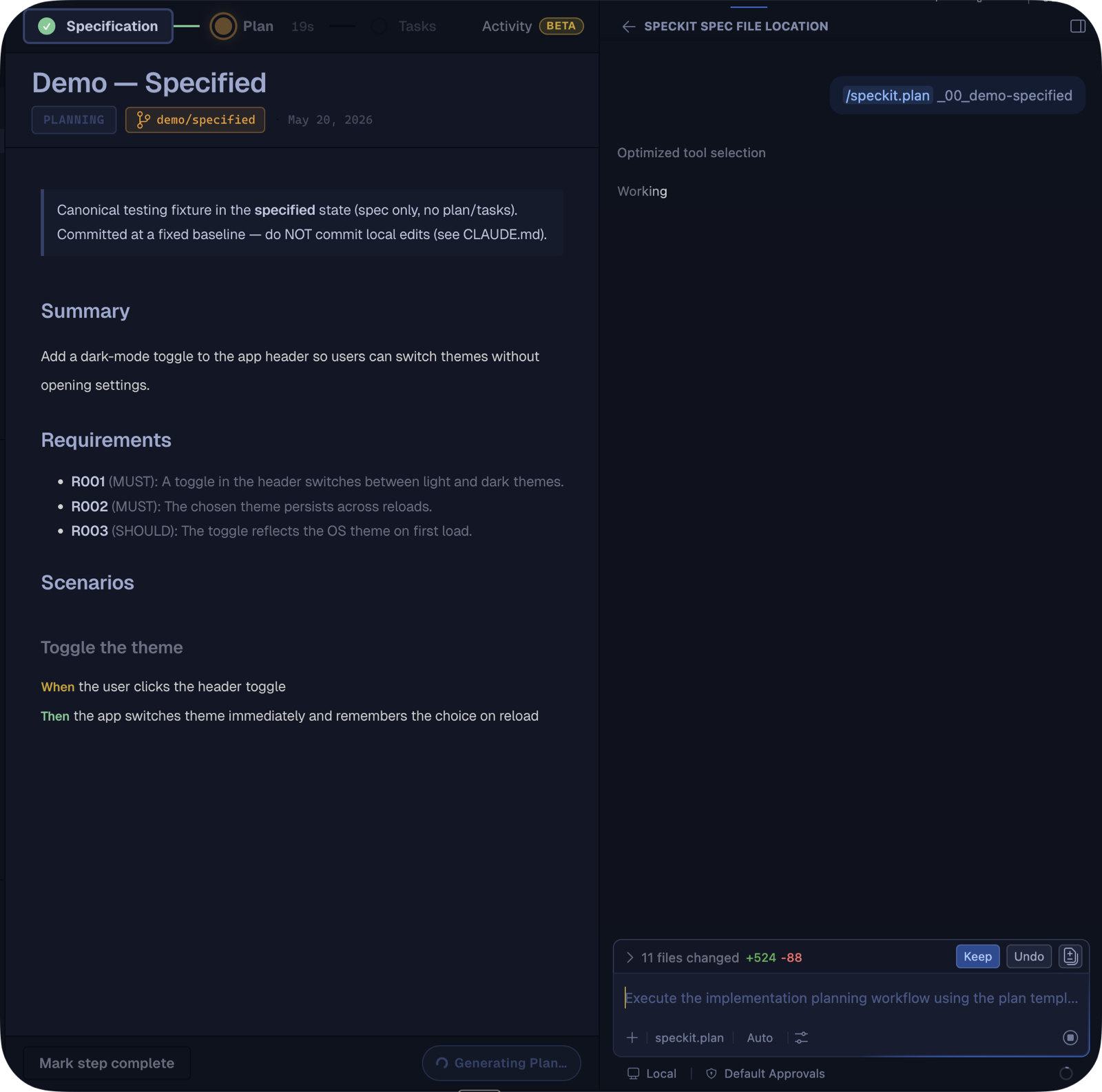
Claude in VS Code dispatches to the Claude Code GUI panel instead of
spawning the claude CLI in a terminal — for users who live in the panel rather
than a terminal. It shares the same .claude/ setup as the terminal claude
provider (steering, agents, hooks, MCP). The extension opens the panel via Claude
Code's URI handler and prefills the command; the Claude Code panel exposes no
programmatic submit, so you press Enter to run it.
Requires the Claude Code extension;
if it isn't installed, the provider suggests switching to terminal claude.
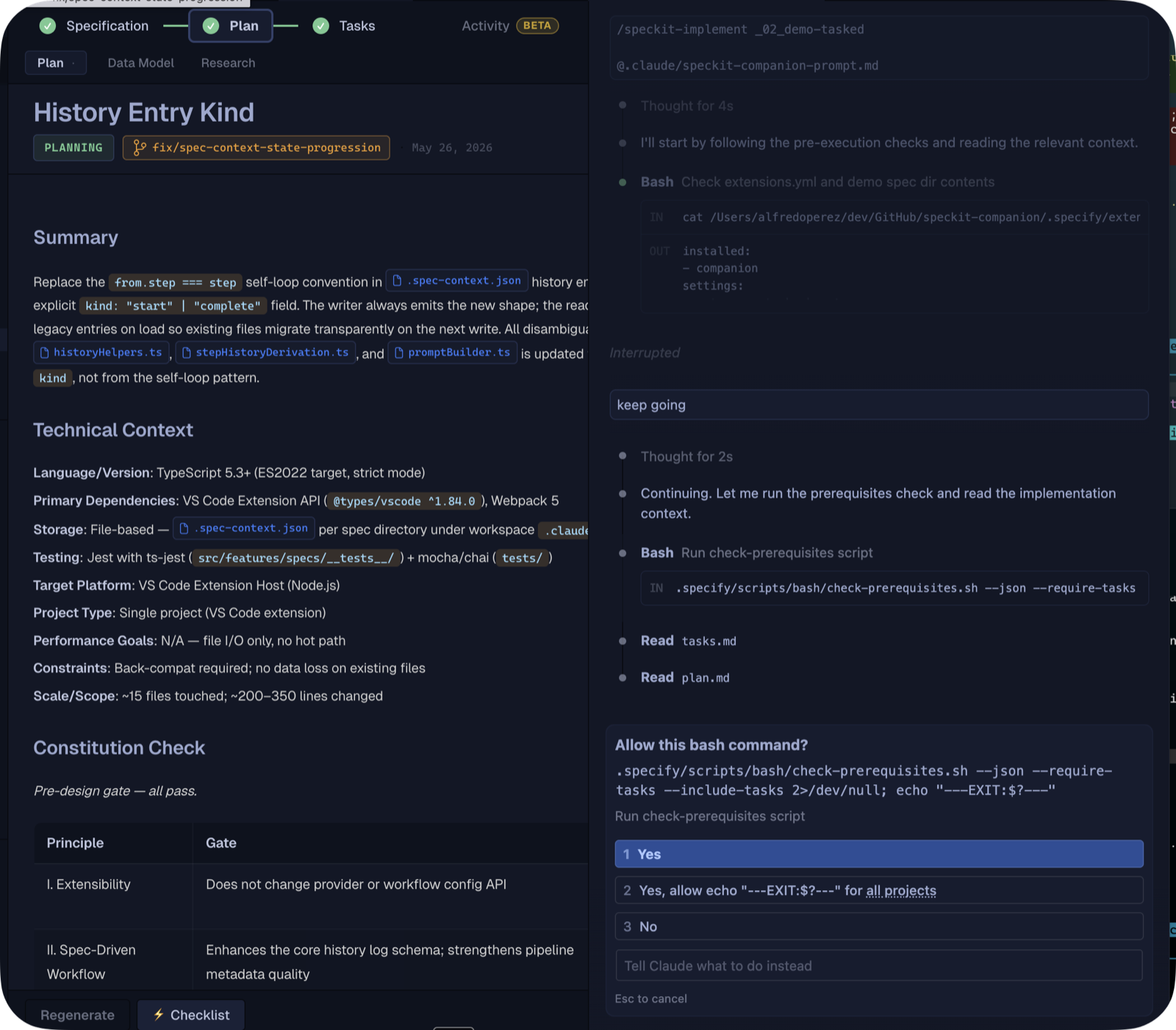
Controls whether AI CLIs run with permission prompts (safe) or bypass them (YOLO):
{
  "speckit.permissionMode": "interactive"
}| Value | Behavior |
|---|---|
"interactive" |
The CLI prompts before taking actions (recommended) |
"auto-approve" |
(YOLO) Skip all permission prompts. Faster but no review of tool calls. |
This applies to all providers that support it: Claude (--permission-mode bypassPermissions), Copilot (--yolo), and Qwen (--yolo). Gemini and Codex ignore this setting.
Copilot exception: GitHub Copilot CLI cannot surface permission prompts in
-pmode. Even withpermissionMode: "interactive", the extension auto-switches Copilot to auto-approve at dispatch time — otherwise the terminal would silently hang waiting for a prompt that never appears. This is enforced at runtime; dismissing the startup warning toast does not re-enable interactive mode for Copilot.
The extension sends anonymous, PII-free usage telemetry to help prioritize which AI providers and pipeline features to invest in. It is gated on two switches — if either is off, nothing is sent:
{
  "speckit.telemetry": true
}| Switch | Effect when off |
|---|---|
speckit.telemetry (default true) |
Disables all extension telemetry, regardless of the global setting |
VS Code's global telemetry.telemetryLevel |
Disables all extension telemetry, regardless of speckit.telemetry |
What is collected (all anonymous):
| Signal | Example value |
|---|---|
| Selected AI provider | claude, copilot, gemini, … |
| Default workflow | speckit / companion |
| Which workflow phase was dispatched | specify / plan / tasks / implement |
| Spec lifecycle counts | created / completed / archived |
| Beta-flag on/off states | a snapshot reported once per session |
| Extension / VS Code versions, spec count | for version distribution and scale |
| Chosen workflow | the built-in id, or the literal custom |
What is never collected: prompt content, file paths, spec names, or custom workflow names — only enum-like values, booleans, versions, counts, and a random per-spec id.
That per-spec id is a random UUID, not the spec name or path. It correlates a single spec's events into a funnel (created → dispatched → completed) without ever revealing which spec it is. It is stored in the spec's .spec-context.json so the same id rides every event for that spec.
The opt-in beta toggles appear under Beta Features in VS Code Settings in adoption-funnel order — the sequence you'd enable them in, not alphabetical:
| Order | Setting | Requires the spec-kit extension? |
|---|---|---|
| 1 | speckit.companion.speckitCompanionWorkflow — turns on the whole SpecKit Companion Workflow (Create-Spec picker + Continue/Resume button) |
Yes |
| 2 | speckit.companion.installPrompt — install banner when the extension is missing; only applies while the Companion workflow is on |
No (it surfaces the missing extension) |
| 3 | speckit.viewer.activityPanel — per-spec Activity timeline in the viewer |
Yes |
The Companion workflow is the master switch: with it off, the workflow picker, the Continue/Resume button, and the install banner all stay hidden — there's nothing to install when the workflow isn't in use. Each setting only functions once the companion spec-kit extension is installed; their descriptions carry that install link, so a toggle that looks inert is usually waiting on the extension. Each setting is detailed in the subsections below.
You make one decision, once: run the stock SpecKit pipeline or the SpecKit Companion pipeline. That choice lives in a single setting, speckit.defaultWorkflow, and is pre-selected in the Workflow dropdown of Create New Spec. There is no separate template-profile, turbo-picker, or fast-path toggle — those three settings have been retired and folded into this one choice.
The Companion option is a beta: the Workflow picker only appears once you turn on speckit.companion.speckitCompanionWorkflow and the companion spec-kit extension is installed. Until then, Create Spec runs stock SpecKit with no picker — so you never see a Companion choice that would silently do nothing.
{
  "speckit.defaultWorkflow": "speckit"
}| Value | Behavior |
|---|---|
"speckit" (default) |
The stock SpecKit pipeline: /speckit.* commands, same sections and files as upstream spec-kit. |
"companion" |
The SpecKit Companion pipeline: the trimmed /speckit.companion.* commands (no user-story section, files/dependencies tasks, a smaller spec folder), built-in right-sizing for small vs. large changes, and a terminal mark-complete step. Requires the companion spec-kit extension. |
The chosen workflow is recorded on the spec at creation and dispatches its command family for every step of the run, so there's no cross-workflow command leakage. Existing users see no change: the default stays speckit.
Right-sizing is built in. What used to be the opt-in "complexity fast-path" now lives inside the Companion workflow itself — its routing step detects a small change and folds the ceremony (skips the review-gate pauses) without you flipping any setting. Larger changes keep the full specify → plan → tasks → implement pipeline.
When the extension is missing. Companion's /speckit.companion.* commands ship with the spec-kit extension. If you pick SpecKit Companion in a project that doesn't have it installed, each step falls back to the stock /speckit.* command and a one-click "Install spec-kit Extension" prompt appears — you never hit an "Unknown command". Full reference in docs/template-profiles.md.
Measured impact comes from a benchmark (/bench-run-all, 2026-06-10): the same feature set built through each workflow at three sizes (easy / medium / hard), in isolated sandbox clones with a deterministic harness plus an independent judge. Wall-clock is a single sample per cell, so read timing as directional.
| Per size (easy / medium / hard) | SpecKit | SpecKit Companion |
|---|---|---|
Spec size (spec.md lines) |
61 / 91 / 94 | 24 / 29 / 36 |
| Throwaway side files written | 3 / 4 / 4 | 0 / 0 / 0 |
| Wall-clock | 2m05s / 4m31s / 7m38s | 3m03s / 5m03s / 5m59s |
Companion specs run roughly 60 to 68% leaner, write zero throwaway side files at any size (research.md / data-model.md / quickstart.md / contracts/), and trend fastest as the feature gets harder. Correctness was a tie: every cell in both workflows shipped a passing, convention-following build (all-green regression suite, 5.0/5 independent-judge rubric), so neither needed rework. The difference is ceremony and progress visibility, not whether the feature works.
A single opt-in beta that defaults to false and turns on the whole SpecKit Companion experience. In VS Code Settings it reads as SpecKit Companion Workflow. With it on, Create Spec offers the SpecKit / SpecKit Companion picker (when the companion extension is installed), the sidebar shows a resume (▶) button on active specs (active / tasks-done), and the install banner can appear when the extension is missing. With it off, all three disappear and you're on stock SpecKit only. Toggling it updates visibility immediately, with no window reload.
{
  "speckit.companion.speckitCompanionWorkflow": false
}| Value | Behavior |
|---|---|
false (default) |
No workflow picker; the resume (▶) button and the install banner are hidden on all specs. |
true |
The picker appears (when the companion extension is installed), the resume (▶) button appears on eligible specs (active / tasks-done), and the install banner appears when the extension is missing. |
This one setting replaces the former separate resume toggle, and was previously keyed speckit.companion.workflowBeta (labeled "Workflow Beta"). A prior speckit.companion.resumeBeta or speckit.companion.workflowBeta opt-in carries over to it automatically on upgrade.
Resume dispatches the command family the spec has been running — a spec on the Companion workflow resumes with /speckit.companion.<step>, a spec on the stock SpecKit workflow resumes with /speckit.<step> — based on the workflow recorded on the spec. This gate lives only in VS Code settings.
Controls how speckit commands are formatted when sent to AI providers:
{
  "speckit.commandFormat": "auto"
}| Value | Behavior |
|---|---|
"auto" |
Let the AI provider decide the format (default) |
"dot" |
Always use dot notation (e.g., speckit.plan) |
"dash" |
Always use dash notation (e.g., speckit-plan) |
Use auto unless your speckit version requires a specific command format. Override with dot or dash when the provider's default doesn't match what your setup expects.
Controls whether the extension prepends a short context-update preamble to every SpecKit step prompt sent to the AI CLI:
{
  "speckit.aiContextInstructions": true
}| Value | Behavior |
|---|---|
true (default) |
Prepend a marker-wrapped preamble that instructs the AI to keep .spec-context.json current, including canonical substeps (e.g., plan.research, plan.design, implement.run-tests). |
false |
Send the raw /speckit.<step> command with no preamble. Useful if your AI ignores it or you're debugging raw prompts. |
The preamble adds ~200–300 tokens per dispatch and is identical across all providers (Claude, Gemini, Copilot, Codex, Qwen). Extension-side step-boundary writes remain the hard guarantee for startedAt / completedAt: this preamble unlocks finer-grained substep tracking.
When a dispatched spec step finishes, the extension shows a VS Code information message naming the spec and step (e.g. Spec 074 · Plan complete). The message includes an Open spec action that focuses the viewer for that spec. VS Code routes info messages to the native OS notification surface when the window is unfocused, so you can tab away during long runs.
{
  "speckit.notifications.stepComplete": true
}
Set to false to silence the message while keeping the in-viewer elapsed timer.
By default, specs are discovered in specs/ and .specify/specs/ (the SpecKit CLI's own layout), so a spec created either way shows up without extra configuration. You can configure additional directories or use glob patterns:
{
  "speckit.specDirectories": ["specs", "openspec/changes/*"]
}
Simple names (e.g., specs) list their children as specs. Patterns with wildcards treat each match as a spec folder.
Define alternative workflows with custom steps, output files, and sub-documents. Any SDD methodology that uses commands and produces markdown files can be plugged into SpecKit Companion.
Here's a full configuration using Agent Teams Lite, a multi-agent SDD framework:
{
  "speckit.customWorkflows": [
    {
      "name": "agent-teams-lite",
      "displayName": "Agent Teams Lite (SDD)",
      "description": "Multi-agent SDD workflow",
      "steps": [
        { "name": "specify", "label": "Spec",   "command": "sdd-spec",   "file": "spec.md", "subDir": "specs" },
        { "name": "plan",    "label": "Design", "command": "sdd-design", "file": "design.md", "includeRelatedDocs": true },
        { "name": "tasks",   "label": "Tasks",  "command": "sdd-tasks",  "file": "tasks.md" }
      ]
    }
  ],
  "speckit.specDirectories": ["specs", "openspec/changes/*", "openspec/changes/archive/*"],
  "speckit.customCommands": [
    { "name": "verify",  "title": "Verify",  "command": "/sdd-verify",  "step": "tasks", "tooltip": "Validate implementation matches specs" },
    { "name": "archive", "title": "Archive", "command": "/sdd-archive", "step": "tasks", "tooltip": "Archive completed change" }
  ]
}
Notice how custom workflows, spec directories, and custom commands work together:
- The workflow defines Spec → Design → Tasks phases with custom labels and commands
specDirectoriestells the sidebar where to find specs (including archived ones)- Custom commands add Verify and Archive buttons to the Tasks phase
{
  "speckit.customWorkflows": [
    {
      "name": "my-workflow",
      "displayName": "My Workflow",
      "steps": [
        { "name": "specify",   "label": "Specify",   "command": "myflow.specify",   "file": "spec.md" },
        { "name": "plan",      "label": "Plan",      "command": "myflow.plan",      "file": "plan.md" },
        { "name": "tasks",     "label": "Tasks",     "command": "myflow.tasks",     "file": "tasks.md" },
        { "name": "implement", "label": "Implement", "command": "myflow.implement", "actionOnly": true }
      ],
      "commands": [
        {
          "name": "auto",
          "title": "Auto Mode",
          "command": "myflow:auto",
          "step": "specify",
          "tooltip": "Goes through the whole specification in auto mode"
        }
      ]
    }
  ]
}Workflows can define commands: extra action buttons that appear next to the primary action for a given step. For example, a command with "step": "specify" renders as a button next to Submit in the spec editor.
{
  "commands": [
    {
      "name": "auto",
      "title": "Auto Mode",
      "command": "/myflow:auto",
      "step": "specify",
      "tooltip": "Runs the full pipeline automatically"
    }
  ]
}| Property | Required | Description |
|---|---|---|
name |
Yes | Unique command identifier |
command |
Yes | Command to execute verbatim (e.g., "/myflow:auto"; include the leading / for slash-command providers) |
step |
Yes | Which workflow step to show this button on (e.g., "specify") |
title |
No | Button label (defaults to name) |
tooltip |
No | Hover text for the button |
Commands with step: "specify" appear as secondary buttons next to Submit in the spec creation dialog. Multiple commands per step are supported.
A workflow can declare which AI providers it supports with supportedAiProviders. When set, the workflow is hidden entirely unless the active speckit.aiProvider is in the list — it disappears from the workflow picker, the spec editor, and every step/footer action. Omit the field (or use an empty array) to support all providers.
{
  "speckit.customWorkflows": [
    {
      "name": "my-workflow",
      "displayName": "My Workflow",
      "supportedAiProviders": ["claude"],
      "steps": [
        { "name": "specify", "label": "Specify", "command": "myflow.specify", "file": "spec.md" }
      ]
    }
  ]
}
A workflow whose commands are implemented as Claude Code skills (e.g. /myflow:*) can declare ["claude"] to keep it from appearing — as a dead, unrunnable path — under GitHub Copilot, Gemini, Qwen, or Codex.
| Property | Required | Description |
|---|---|---|
supportedAiProviders |
No | Array of provider ids the workflow supports: claude, gemini, copilot, codex, qwen, opencode, ide-chat, claude-vscode. Omit or leave empty for all providers. An unknown id matches no real provider, hiding the workflow everywhere. |
The built-in default workflow has no declaration and is always available, so at least one workflow is always selectable regardless of provider.
Steps can declare child documents that appear as expandable items in the sidebar:
{
  "steps": [
    {
      "name": "plan",
      "label": "Plan",
      "command": "speckit.plan",
      "file": "plan.md",
      "subDir": "plan"
    }
  ]
}
This scans plan/ for .md files and shows them as children of the Plan step. You can also use an explicit list:
{
  "subFiles": ["plan/architecture.md", "plan/api-design.md"]
}| Property | Required | Description |
|---|---|---|
name |
Yes | Step identifier (e.g., "specify", "design") |
command |
Yes | Slash command to execute (e.g., "myflow.specify") |
label |
No | Display name in sidebar (defaults to capitalized name) |
file |
No | Output file for this step (defaults to {name}.md) |
actionOnly |
No | When true, the step has no output file and is hidden from the document tree (e.g., an "Implement" step that just runs a command) |
subFiles |
No | Array of child file paths shown under this step |
subDir |
No | Directory to scan for child .md files (non-recursive) |
includeRelatedDocs |
No | When true, unassigned .md files in the spec folder are grouped under this step. Only one step should have this flag. |
- The sidebar shows only the steps declared by the active workflow
- Steps with missing output files appear as "not started"
- Steps with
actionOnly: trueare action-only. They appear in the workflow editor but not in the file tree - When a spec is created via the editor, the selected workflow is automatically persisted to
.spec-context.jsonin the spec directory - If no workflow is selected, the
speckit.defaultWorkflowsetting is used (falls back to the built-in default) - Once persisted, all subsequent operations (viewer, step execution, command palette) use the same workflow consistently
- The default workflow (
spec.md→plan.md→tasks.md→ implement) is always available
Add custom slash commands that appear in the workflow editor and the SpecKit: Run Custom Command picker.
{
  "speckit.customCommands": [
    "review",
    {
      "name": "commit",
      "title": "Commit Changes",
      "command": "/speckit.commit",
      "step": "tasks",
      "tooltip": "Generate a commit for completed work",
      "requiresSpecDir": false
    },
    {
      "name": "pr",
      "title": "Create PR",
      "command": "/speckit.pr",
      "step": "tasks",
      "tooltip": "Create a pull request for the feature"
    }
  ]
}
Properties:
name: Command identifiertitle: Display name in pickercommand: Slash command to executestep: Phase to show in:spec,plan,tasks, orall(default)tooltip: Description shown on hoverautoExecute: Auto-run in terminal (default: true)requiresSpecDir: Inject spec directory (default: true)
Every spec directory holds a .spec-context.json file that is the single
source of truth for lifecycle state. The viewer derives badges, pulse,
highlight, and footer button visibility from this file only. File
existence is never used to infer step completion.
{
  "workflow": "speckit | companion | <custom>",
  "specName": "060-spec-context-tracking",
  "branch": "060-spec-context-tracking",
  "currentStep": "specify | clarify | plan | tasks | analyze | implement",
  "status": "draft | specifying | specified | planning | planned | tasking | ready-to-implement | implementing | completed | archived",
  "history": [
    { "step": "specify", "substep": null, "from": { "step": null, "substep": null }, "by": "extension", "at": "ISO" }
  ]
}
history[] is the single append-only source of truth for step
boundaries. Per-step timing (start / completion / substeps) is derived
in-memory by the viewer; it is not persisted. Files written by older
versions that still carry stepHistory or transitions are accepted on
read and migrated on the next write.
The full JSON Schema lives at
src/core/types/spec-context.schema.json and
specs/060-spec-context-tracking/contracts/spec-context.schema.json.
The extension appends a history[] entry — start or completion — and
flips the canonical status whenever a step is dispatched (via the
SpecKit commands or the viewer's next-step / Regenerate buttons — the
next-step button is labelled with the upcoming phase name, e.g. Plan,
Tasks, Implement, or Complete on the final step), and when a
spawned terminal closes, independent of AI cooperation. Spec status
changes (Mark as Completed, Archive, Reactivate) write the
canonical status and append a history entry. Write failures log to the
SpecKit output channel without blocking dispatch.
Advancing currentStep is atomic: setting it to a new step always
appends the matching start-entry in the same write. currentStep ahead
of history[] is the failure mode that makes the viewer show a fake
"Generating …" with no actual progress.
- Unknown top-level fields are preserved across writes.
historyis append-only. Never rewrite prior entries.- The last
history[]entry'sstepmatchescurrentStep. - When the viewer opens a spec with no context file, it writes a minimal
draftdocument; no step is marked completed from file presence alone.
draft → specifying → specified → planning → planned → tasking →
ready-to-implement → implementing → completed → archived.
Legacy shapes (status: "active", status: "tasks-done", or files that
only contain { status: "completed" }) are coerced by
normalizeSpecContext at read time.
A .spec-context.json that is syntactically broken — a truncated write, a hand edit, or merge-conflict markers — cannot be parsed, so the viewer falls back to a read-only, draft-state render of the spec. Instead of failing silently, it surfaces an error notification naming the JSON parse error and the offending file path, with a Reset context action. Choosing Reset context moves the broken file aside to a timestamped backup (.spec-context.json.bak-<timestamp>) and writes a fresh minimal skeleton in its place, then reloads the viewer. The original bytes are never overwritten in place — they survive in the backup so you can salvage lifecycle history by hand. Dismissing the notification leaves the broken file untouched; reopening the spec re-offers the reset. (This covers JSON-syntax failures only — a file that parses but is semantically off is tolerated and coerced as above.)
git clone https://github.com/alfredoperez/speckit-companion.git
cd speckit-companion
npm install
npm run compile- Open the project in VS Code
- Press
F5to launch Extension Development Host
npm run package
# Output: speckit-companion-{version}.vsix| Platform | Support | Notes |
|---|---|---|
| macOS | Yes | Fully supported |
| Linux | Yes | Fully supported |
| Windows WSL | Yes | Supported |
| Windows | Yes | All bash-only providers (Copilot, Claude, OpenCode, Qwen) auto-detect PowerShell and use the equivalent Get-Content -Raw substitution; cmd.exe is supported on a best-effort basis (long prompts may exceed cmd's 8191-char line limit — switch to PowerShell or Git Bash if you hit it). |
PRs welcome. See CONTRIBUTING.md for local setup, the F5 dev-host loop, test conventions, the Conventional Commit style this repo uses, and the README docs map you should follow before opening a PR.
This project started from the amazing work at https://github.com/notdp/kiro-for-cc
MIT License