
Networks that don't exist until they're needed.
nullnet.ai · silence by default — every connection is earned, then erased
Most networks are default-open: everything can talk to everything, and a firewall claws the attack surface back down rule by rule. The surface starts as the entire network.
NullNet flips the logic. By default, nothing can talk to anything. A service can't reach another until the moment it genuinely needs to — the connection is built right then, just for that one conversation, and torn down once it's done.
There is no pre-built network waiting to be attacked — because there is no pre-built network at all.
Break in somewhere and there's no internal network to roam. The only paths that exist are the narrow, temporary ones carrying legitimate traffic right now.
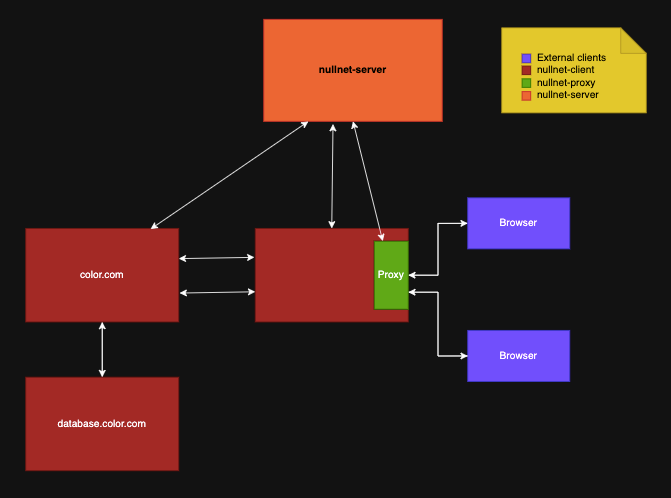
A request comes in. The server walks the entire chain it will travel — if A needs B, and B needs C, that one request opens every link atomically, so the full path is ready at once. Each link is a dedicated VXLAN tunnel, private between two machines and alive only while in use; go idle past the timeout and the server tears it down.
Three components coordinate over a gRPC control plane:
| Component | Role |
|---|---|
| 🧠 nullnet-server | The brain — the only piece that sees the whole picture. Holds the topology of who may talk to whom, and decides when to build each connection. |
| 🛰️ nullnet-client | The agent on each machine. Announces local services and watches for them reaching out — pausing the first request just long enough to have the path built. |
| 🚪 nullnet-proxy | The front door. The ingress edge for outside traffic, asking the server to build whatever's needed to deliver each request. |
- ⚡ On-demand tunnels — connections are blueprints, not roads.
- ⏱️ Millisecond setup — paths built the instant a request appears, erased when idle.
- 🎯 Millisecond attack surface — nothing standing to scan, pivot through, or persist on.
- 🔒 A private network per client — never a shared fabric.
- 🦀 Rust performance & safety — fast and memory-safe end to end.
Stop carving down an always-on attack surface. Start with one that never exists in the first place.